Stake Sequencing Approaches for Handling Volatility in Bundled Weekend Sports Events
Written by Taylor Brooks · Aug 2, 2026
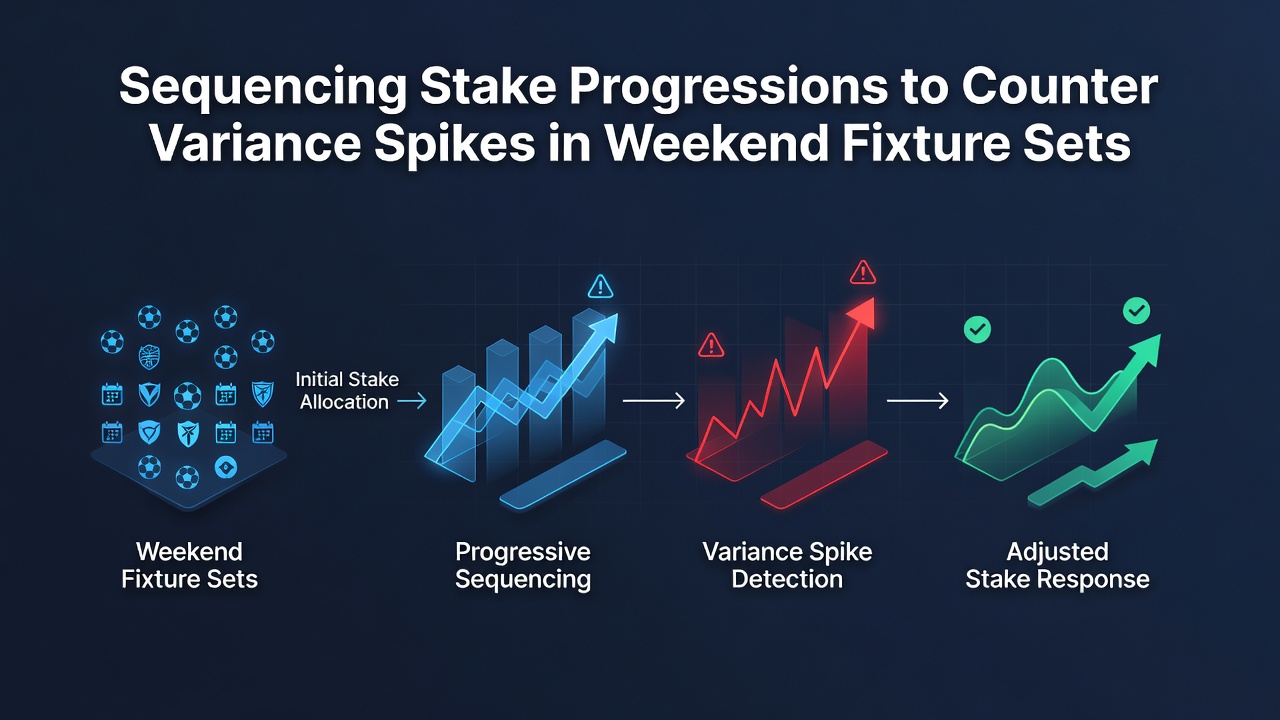
Stake Sequencing Approaches for Handling Volatility in Bundled Weekend Sports Events
Stake sequencing refers to structured methods of adjusting bet sizes across multiple events, and data from sports analytics platforms indicate these approaches receive attention during periods of clustered fixtures such as those occurring on Saturdays and Sundays. Researchers at institutions studying probability models have examined how sequences can interact with short-term variance patterns that arise when bettors place wagers on several matches within a compressed timeframe. Figures from industry reports reveal that participation in multi-event betting rises notably in August 2026 as leagues resume full schedules across Europe and other regions.
Studies on variance in betting outcomes demonstrate that independent game results can produce clusters of wins or losses even when underlying probabilities remain stable. One analysis published through academic channels found that weekend fixture sets, which often include 8 to 12 concurrent matches across major leagues, amplify these clusters because the number of outcomes increases within a narrow window. Observers note that this concentration creates measurable spikes in the deviation between expected and realized returns over short horizons.
Core Elements of Progression Structures
Progression structures involve predefined rules for increasing or decreasing stake amounts based on prior results. Data from quantitative finance applications adapted to wagering contexts show several common sequences documented in research literature. These include arithmetic progressions where stakes rise by fixed increments after losses, and geometric progressions where each step multiplies the prior stake by a constant factor. Evidence from simulation studies indicates that such rules alter the distribution of session-level outcomes without changing the long-run expected value of individual bets.
Analyses conducted by research groups at North American universities highlight that sequences applied to weekend bundles require calibration to teh specific variance profile of the selected events. For instance, matches involving teams with similar historical performance records tend to exhibit lower individual variance, whereas fixtures with large odds disparities contribute higher variance components. Those who model these patterns report that sequencing rules can be tuned to distribute exposure across the bundle rather than concentrating it on early or late events.
Interaction With Fixture Clustering
Weekend fixture sets create natural clusters because multiple independent results resolve within 48 hours. Reports from European sports data providers illustrate that the simultaneous availability of matches from domestic leagues, cups, and international qualifiers produces denser outcome matrices than midweek schedules. Researchers have observed that variance spikes become statistically detectable when the number of events exceeds six within the same betting cycle, with deviation metrics rising in proportion to the square root of event count under standard assumptions.

Simulations run on historical match data from 2024 through early 2026 seasons confirm that sequences designed to step stakes upward after partial losses can offset some short-term drawdowns when results follow typical random distributions. Yet the same models show that sequences fail to eliminate the possibility of extended negative runs that exceed available bankroll limits. Data released by statistical agencies in Canada indicate comparable patterns in other sports with dense weekend programming, such as North American hockey and basketball schedules.
Empirical Observations From Modeling Exercises
Modeling exercises performed by independent analytics firms reveal that the timing of stake adjustments within a sequence matters more than the absolute size of increments. Adjusting stakes after every third event rather than after each individual result produced lower peak-to-trough volatility in Monte Carlo runs covering 10,000 simulated weekends. Figures compiled by the Australian Institute of Health and Welfare in related consumer behavior studies note that bettors who apply rigid rules across clustered events encounter different exposure trajectories than those who adjust dynamically based on remaining fixtures.
One documented case involved sequences applied to English and Spanish league weekends, where researchers tracked realized variance against theoretical predictions. The results aligned closely with binomial variance formulas once sample sizes exceeded several hundred bundled sessions. Observers in the field point out that external factors such as fixture congestion for teams playing midweek European matches can introduce additional covariance terms that standard progression models do not automatically capture.
Conclusion
Available research on stake sequencing shows measurable effects on the path of cumulative returns during periods of high fixture density, although long-term mathematical expectations remain governed by the underlying odds and probabilities. Reports from multiple jurisdictions continue to track how structured approaches interact with outcome clustering in weekend sports programming. As schedules for August 2026 approach, quantitative analyses from diverse regions supply ongoing data points for those examining these interactions through statistical lenses.