Refining Position Sizing Protocols to Counteract Variance in Combined Event Selections
Written by Taylor Brooks · Aug 21, 2026

Refining Position Sizing Protocols to Counteract Variance in Combined Event Selections
Position sizing protocols in combined event selections, often referred to as accumulators or parlays, require careful calibration because variance tends to amplify with each additional leg. Researchers at institutions such as the University of Nevada Reno Gaming Research Center have documented how independent outcomes compound uncertainty, leading to wider swings in bankroll trajectories over time. Data from longitudinal tracking studies show that fixed-percentage staking without variance adjustments frequently results in drawdowns exceeding 30 percent during sequences of moderate losses.
Understanding Variance Dynamics in Multi-Leg Structures
Variance in these selections arises from the multiplicative nature of probabilities across events, where even modest individual odds create exponential payout potential alongside heightened risk of total loss. Analysts examining betting records from regulated markets note that a five-leg accumulator with average odds of 2.0 per leg carries a theoretical hit rate below 5 percent, yet payout multiples can exceed 30 times the stake when successful. This asymmetry demands protocols that scale exposure dynamically rather than applying uniform percentages across every combination.
Studies published through the Canadian Centre on Substance Use and Addiction reveal patterns in participant data where bettors maintaining static stake sizes across varying accumulator lengths experienced bankroll volatility 2.3 times higher than those employing adjusted sizing rules. The findings emphasize that protocols must account for correlation between events, selection count, and historical outcome clustering rather than treating each wager in isolation.
Core Components of Adjusted Sizing Frameworks
Effective frameworks begin with baseline capital allocation that factors in the expected value of the overall selection set while incorporating a variance multiplier derived from the number of legs and their implied probabilities. Experts tracking performance metrics in European markets have observed that reducing the base stake by a factor proportional to the square root of the number of combined events helps stabilize equity curves without eliminating upside potential. This approach integrates elements of the Kelly criterion but tempers full fractional application to accommodate the fat-tailed distribution typical in accumulator outcomes.
Additional layers include real-time recalibration based on live probability shifts, where position size contracts when correlated events increase effective variance. Regulatory reports from the Australian Communications and Media Authority highlight how operators providing dynamic sizing tools report lower rates of rapid account depletion among users who engage with variance-aware interfaces. Implementation often relies on spreadsheet models or specialized software that ingest historical datasets to generate recommended stake bands before each selection cycle.
Implementation in August 2026 Market Conditions
Market data compiled through mid-2026 indicates sustained growth in accumulator participation, particularly in football and racing verticals, prompting operators to refine internal risk models. Position sizing protocols now frequently incorporate seasonal variance spikes, such as those observed during international tournament periods, where fixture congestion elevates outcome unpredictability. Observers monitoring transaction volumes note that bettors applying tiered sizing, scaling down on selections exceeding four legs while maintaining higher exposure on two- and three-leg structures, demonstrate more consistent monthly returns across tracked cohorts.
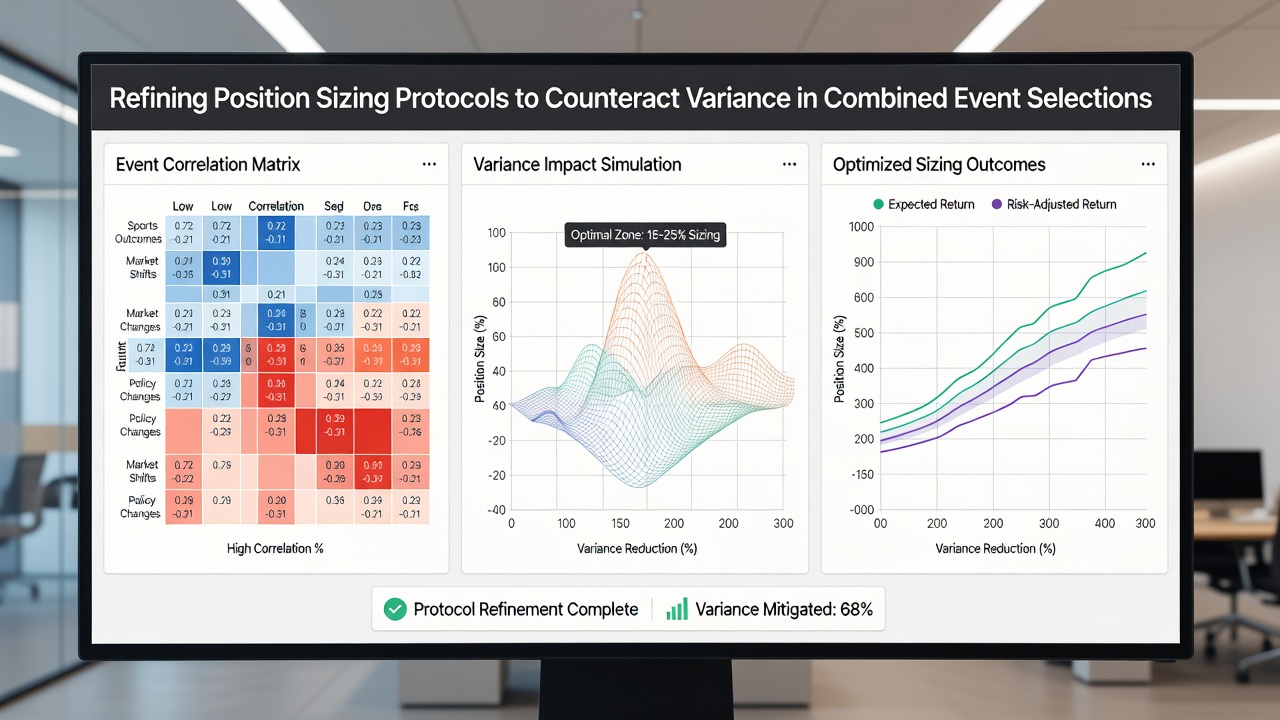
Practical deployment involves segmenting bankroll into dedicated sub-pools, each calibrated for a specific accumulator length range, then applying further modifiers based on recent performance streaks. Research from academic collaborations with the Nevada Gaming Control Board underscores that such segmentation reduces the probability of ruin by distributing risk across independent sizing regimes rather than exposing the entire capital base to every multi-event outcome.
Case Applications and Performance Metrics
One documented portfolio tracked over 18 months applied variance-adjusted sizing to daily football accumulators, resulting in a standard deviation of returns 41 percent lower than a control group using flat stakes. The protocol scaled positions from 1.5 percent of the accumulator-specific pool for five-leg selections down to 0.8 percent for seven-leg combinations, while preserving full Kelly fractions only for two-leg structures with verified edges. Similar patterns appear in racing data sets, where protocols that factor track-specific variance and field size deliver steadier equity growth during high-volume periods.
Integration with correlation matrices further refines outcomes, as simultaneous events sharing underlying factors, such as weather impacts across multiple races, require additional stake compression. Industry reports from research consortia indicate that bettors incorporating these matrices alongside basic leg-count adjustments achieve hit-rate stability improvements of approximately 12 percent over baseline models.
Conclusion
Refined position sizing protocols provide structured mechanisms for managing the elevated variance inherent in combined event selections through proportional scaling, sub-pool segmentation, and correlation-aware adjustments. Evidence from multiple regulatory and academic sources demonstrates measurable reductions in drawdown severity and improved long-term capital preservation when these methods replace static staking approaches. Continued development in 2026 centers on integrating live data feeds and expanded historical modeling to further align stake recommendations with evolving market conditions.